Dental Publication / Article Details |
|
Advantages of the Root Submergence Technique for Pontic Site Development in Esthetic Implant Therapy
Author(s):
Maurice Salama, DMD;Henry Salama, DMD;Akiyoshi Funato, D.D.S.;Tomohiro Ishikawa, DDS;David Garber, DMD
Date Added:
5/15/2012
|
Summary:
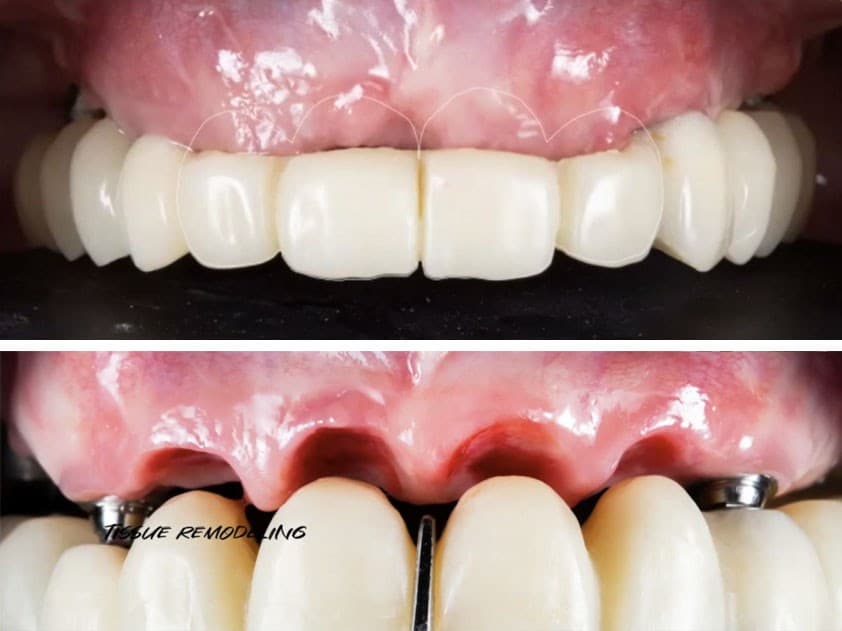
A single-tooth implant in the esthetic region has good potential for success, but it is still challenging to restore multiple-tooth defects with implant-supported prostheses that resemble the natural dentition. This article suggests a strategy to provide a more predictable protocol for esthetic implant treatment for multiple-tooth defects using the root submergence technique (RST). By maintaining the natural tooth root with the RST, a much greater amount of surrounding tissue may be preserved than with the commonly used socket preservation technique, which almost always leads to crestal bone resorption and thus reduction of the height of the interdental papillae and width of the edentulous ridge. RST instead maintains the natural attachment apparatus of the tooth in the pontic site, which in turn allows for complete preservation of the alveolar bone frame and assists in the creation of an esthetic result in adjacent multiple-tooth-replacement cases. In situations with periodontal bone loss, orthodontic extrusion is required to create the underlying bone support for the papilla that is necessary to guarantee predictability. (Int J Periodontics Restorative Dent 2007;27:521–527.)
|
|
Related Articles |
|
|
|
Placing Dental Implants and/or Natural Tooth Restorations in the Esthetic Zone
A key goal of aesthetic/cosmetic dentistry is the fabrication of maintainable, aesthetic, and functional prostheses that preserve the health of the teeth and soft tissues. Advances in restorative dentistry have significantly improved the clinician’s ability to deliver predictable treatment. When implants are indicated, osseointegration is an added factor that is essential for success. It is universally accepted that implant dentistry is a restorative-driven treatment with a surgical component. Whether…
| Author(s): |
Lee H. Silverstein, DDS, MS, FACD, FICD;Gregori M. Kurtzman, DDS |
|
View Article>>
|
|
|
|
|
Cortical Tenting Grafting Technique in the Severely Atrophic Alveolar Ridge for Implant Site Preparation
Tenting of the periosteum and soft tissue matrix using a
cortical bone block maintains space and minimizes resorption of the particulate allograft volume. In addition,bridging the cortical blocks with particulate bone avoids unaesthetic ridge defects between cortical block grafts in larger ridge defects. The result was
a more uniform and esthetic alveolar ridge, capable of maintaining an implant-supported prosthesis. The
technique offers predictable functional
and esthetic reconstruction of large volume defects without extensive amounts of autogenous bone. This of-
fers a superior functional and esthetic result than with either cortical or particulate grafting alone.
| Author(s): |
Bach Le, DDS, MD, FICD;Jeffrey Burstein, DDS, MD; P. Parish Sedghizadeh, DDS, MS |
|
View Article>>
|
|
|
|
Related Videos |
|
|
|
|
Flapless Implant Surgery
The science and art of tooth replacement.
| Presented By: |
William Becker, DDS, MSD, Odont.Dr.(hc);William Becker, DDS, MSD, Odont.Dr.(hc), John Doerr |
| Presentation Style: |
Lecture |
| Community Rating: |
|
|
Watch Now>>
|
|
|
|
Related Courses |
|
|
All-On-Four Implant Protocol - Fad or Phenomena
This webinar with Dr. George Duello and Dr. Maurice Salma will discuss the various treatment options available today for this patient segment and emphasize when and where the All-On-Four protocol can be successfully utilized to eliminate the need for costly augmentation procedures and months of healing time.
| Presented By: |
George V. Duello, DDS, MS |
| Presentation Style: |
Online Course |
| CE Hours: |
1 CEU (Continuing Education Units) |
|
Watch Now>>
|
|
|
|
|
Controversies Surrounding Delayed vs. Immediate Implant Placement: Is There No Middle Ground?
This presentation looks critically at the literature and attempts to give clinicians a more flexible approach to immediate and delayed implant placement. Critical surgical guidelines and clinical pearls will be offered for both types of treatment as well as the management of some of the complications that may arise from immediate or delayed implant placement.
| Presented By: |
Howard Gluckman, BDS, MChD |
| Presentation Style: |
Online Course |
| CE Hours: |
1 CEU (Continuing Education Unit) |
|
Watch Now>>
|
|
|
|
|
Zygomatic Implants in the Treatment of Fully Edentulous Patients
This presentation aims to bring some possibilities in the treatment of edentulous patients with a severe atrophic maxilla. The major problem is that the absence of an appropriate bone bed, will compromise any approach with bone grafts and substitutes, as well as involving a greater morbidity and treatment time. In this way the oral rehabilitation with zygomatic implants is a current need for many patients, which will require a scientific knowledge of the dental care professional. Through this slide show and video demonstration you will be able to recognize and diagnose cases recommended for the therapy with zygomatic implants and its possible configurations supporting an oral rehabilitation.
| Presented By: |
Alexander D. Salvoni, PhD |
| Presentation Style: |
Online Course |
| CE Hours: |
1 CEU (Continuing Education Unit) |
|
Watch Now>>
|
|
|
|
|