Dental Education
Online Dental Education Dental education lectures and videos Online dental ce Dental education articles Expert dental educators Dental products education Dental Community
 
Dental Publication / Article Details

The Bio-Derm Ridge Plumping Technique for Pontic Site Development The Bio-Derm Ridge Plumping Technique for Pontic Site Development

Author(s):

Nicholas Toscano, DDS, MS;Dan Holtzclaw, DDS, MS

Date Added:

2/15/2010


Summary:

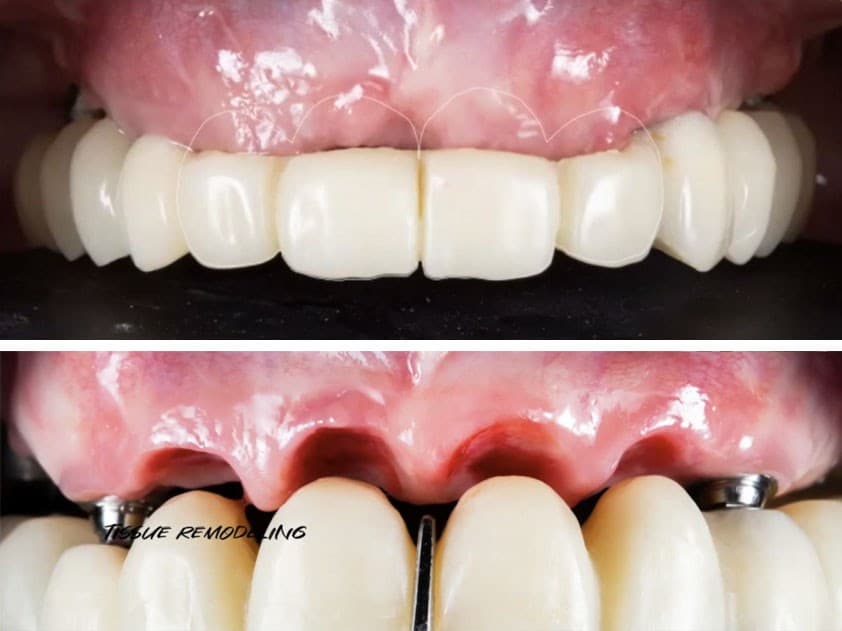
In the esthetic zone of the maxilla a proper emergence profile, predicated on healthy normal marginal gingival tissues with intact interdental papillae, is critical to achieving esthetically pleasing traditional fixed and implant supported restorations. Adequate soft tissue morphology, however, is dependent upon a stable, adequate volume of underlying bone capable of serving as a viable, biologic foundation for overlying soft tissues. Without the harmony afforded by a proper balance of underlying bone and overlying soft tissue, esthetic restorations are not possible, especially in the anterior maxilla. Frequently, however,alveolar bone loss disturbs that critical balance,resulting in marginal tissue distortion, recession and loss of esthetically crucial interdental papillae. Bone loss is common in the esthetic zone and can result from multiple precipitating events, the most common following tooth extraction. Multiple studies have documented predictable 3 mm to 4 mm of buccolingual and apicocoronal ridge resorption within 6 months after removal of maxillary anterior teeth. If left untreated up to 50% buccolingual bone loss will occur after one year post tooth removal in the critical esthetic zone.

Related Articles
Multitier Technique for Bone Augmentation Using Intraoral Autogenous Bone Blocks

Multitier Technique for Bone Augmentation Using Intraoral Autogenous Bone Blocks
Brånemarket al1 originally described autologous bone grafts used with dental implants,and they are now a well-accepted procedure in oral and maxillofacial rehabilitation. Placement of an end osseous implant requires sufficient bone volume for complete bone coverage.Further-more,the patter no fridge resorption ,which contributes to a nun favorable maxillo mandibular relationship,requires angulation of the implant and/or angled abutment,and affects the proximity of adjacent facial concavities (maxillary sinus,nasal cavity)and vital structures(mandibular nerve).

Author(s): Devorah Schwartz-Arad, DMD, PhD;Liran Levin, DMD
View Article>>
Minimally Invasive Alveolar Ridge Augmentation Procedure (Tunneling Technique) Using rhPDGF-BB in Combination with Three Matrices: A Case Series

Minimally Invasive Alveolar Ridge Augmentation Procedure (Tunneling Technique) Using rhPDGF-BB in Combination with Three Matrices: A Case Series
This study investigated a minimally invasive surgical procedure for alveolar ridge augmentation that combined recombinant human platelet-derived growth factor BB (rhPDGF-BB) and three different matrices.

Author(s): Myron Nevins, DDS;Marc L. Nevins, DMD, MMSc; Marcelo Camelo, DDS; Peter Schupbach, PhD; Bernard Friedland, BChD, MSc, JD; Joao Marcelo Borges Camelo, DDS; David M. Kim, DDS, DMSc
View Article>>
Retrospective Evaluation of Crestal Bone Changes Around Implants With Reduced Abutment Diameter Placed Non-Submerged and at Subcrestal Positions: The Effect of Bone Grafting at Implant Placement

Retrospective Evaluation of Crestal Bone Changes Around Implants With Reduced Abutment Diameter Placed Non-Submerged and at Subcrestal Positions: The Effect of Bone Grafting at Implant Placement
One method to measure the success of dental implant treatment is to evaluate marginal peri-implant bone-level changes and stability over time. The location of the fixture–abutment interface (FAI) can be of major importance when the goal is to construct esthetic restorations. In these situations the FAI is often placed in a more apical position to create an ideal emergence profile for the prosthetic construction. However, several animal studies have reported that placement of the FAI in a subcrestal position may result in peri-implant marginal bone loss. The aim of the present study is to evaluate the effect of bone grafting of the defect between the bone crest and the coronal aspect of the implant for implants with reduced abutment diameters placed non-submerged and in subcrestal positions.

Author(s): Alan Fetner, DMD;Theofilos Koutouzis, DDS; Michael Fetner, DMD; Tord Lundgren, DDS
View Article>>
Related Videos
New Age Esthetics: Integration of Tissue Reconstruction, Tooth Replacement and Ceramics Premium Member Content

New Age Esthetics: Integration of Tissue Reconstruction, Tooth Replacement and Ceramics
Dr. Miguel Stanley exhibits detailed clinical cases that represent his "No Half Smiles" philosophy integrating site development, tooth replacement and esthetic composition.

Presented By: Miguel Stanley, DDS
Presentation Style: Lecture
Community Rating:
 
Watch Now>>
rhBMP-2 Infuse and Titanium Mesh Utilized for Regeneration of the Posterior Mandible Premium Member Content

rhBMP-2 Infuse and Titanium Mesh Utilized for Regeneration of the Posterior Mandible
BMP-2, bone morphogenic protein and the concepts of GBR are featured in this case report.

Presented By: Maurice Salama, DMD
Presentation Style: Video
Community Rating:
 
Watch Now>>
The Use of SonicWeld Ultrasonically Fabricated Barriers for Enhanced Outcomes in Guided Bone Regeneration Premium Member Content

The Use of SonicWeld Ultrasonically Fabricated Barriers for Enhanced Outcomes in Guided Bone Regeneration
This video will outline the basic science, clinical techniques and outcomes of the SonicWeld technique.

Presented By: Kevin George Murphy, DDS, MS
Presentation Style: Lecture
Community Rating:
 
Watch Now>>
Related Courses
Creative Next Generation Surgical Tools and Solutions for the Implant Practice Premium Member Content

Creative Next Generation Surgical Tools and Solutions for the Implant Practice
Modern Bone Grafting has become more predictable than ever before. Recent developments in CBCT 3D Diagnosis and the utilization of bioactive modifiers such as PRGF, PRF and BMP-2 have stimulated further advances in surgical techniques as well as a New Age Surgical Armamentarium to maximize the efficiencies and success of these sophisticated procedures.

Presented By: Maurice Salama, DMD
Presentation Style: Online Course
CE Hours: 1 CEU (Continuing Education Unit)
Watch Now>>
Alveolar Ridge Regenerative Strategies: Autogenous Bone vs BMP-2 Premium Member Content

Alveolar Ridge Regenerative Strategies: Autogenous Bone vs BMP-2
This clinical based presentation will compare the use of autogenous bone vs BMP-2 for alveolar ridge reconstruction. The science, indications, advantages and disadvantages of each approach will be featured. Single tooth to full arch reconstruction cases will also be shown along with understanding the application of non-resorbable vs resorbable mesh barriers for alveolar ridge reconstruction.

Presented By: Michael A Pikos, DDS
Presentation Style: Online Course
CE Hours: 1 CEU (Continuing Education Unit)
Watch Now>>
Osseointegration & Augmentation Premium Member Content

Osseointegration & Augmentation
A 4 part course worth 1 CEU.

Presented By: Maurice Salama, DMD;Ziv Mazor, DMD;Hom-Lay Wang, DDS, MSD, PhD;Ady Palti, DDS
Presentation Style: Online Course
CE Hours: 1 CEU (Continuing Education Unit)
Watch Now>>
Download Now

Important!

To view this dental publication or article, you must be a registered user of Dental XP. If you are already a member, click here to login.

Registration is free and only takes several minutes. Dental XP will never spam you, or sell your information.

Join For Free

Sponsor(s)

This dental article or publication is brought to you in part by:

JIACD
Contact Us | Privacy Policy | Terms of Use
©2013

Preferred Language: English Flag
Contact Us · Login · Register