Dental Publication / Article Details |
|
Influence of a Nanometer-Scale Surface Enhancement on De Novo Bone Formation on Titanium Implants
Author(s):
Tiziano Testori, MD, DDS, FICD;Ronnie J. Goene, DDS, Paolo Trisi, DDS, PhD
Date Added:
1/1/2007
|
Summary:
In this prospective randomized controlled clinical study, small titanium implants were placed in posterior maxillae for the purpose of assessing the rate and extent of new bone development. Nine pairs of site evaluation implants were placed in posterior areas of maxillae and retrieved with trephine drills after 4 or 8 weeks of unloaded healing. The amount of bone in linear contact (%) with the implant surface was used to determine the osteoconductive potential of the implant surface. Implant surfaces were dual acid etched (n=9) (controls) or dual acid etched and (test implants), and the surfaces were compared. The implants and surrounding tissues were processed for histologic analysis. The mean bone-to-implant contact value for the test surface was signifivantly increased over that of the control implants at both time intervals (<.01). FOr the implants/patients included in this study, the addition of a nanometer-scale calcium phosphate treatment to a dual acid-etched implant surface appeared to increase the extent of bone development after 4 & 8 weeks of healing. (int J Periodontics Restorative Dent 2007;27:211-219)
|
|
Related Articles |
|
|
Minimally Invasive Antral Membrane Balloon Elevation – Results of a Multicenter Registry
The challenge of bone augmentation of this segment has been traditionally addressed by two approaches: lateral maxillary window and the “osteotome technique,” also called bone-added osteotome sinus floor elevation (BAOSFE).
| Author(s): |
Ziv Mazor, DMD;Efraim Kfir, DMD; Moshe Goldstein, DMD; Israel Yerushalmi, DMD; Ronen Rafaelov, DMD; Vered Kfir, DMD; Edo Kaluski, MD, FACC, FESC, FSCAI |
|
View Article>>
|
|
|
|
|
Techniques for the Use of CT Imaging for the Fabrication of Surgical Guides
Implant dentistry has evolved into one of the most predictable treatment alternatives for partially and completely edentulous patients. The initial excitement about successful osseointegration has allowed clinicians to offer an extended set of treatment alternatives that include single tooth replacement to full mouth reconstruction. Pioneering protocols of the early 1980s relied on a two-stage surgical approach that allowed for the biological aspects of osseointegration to be achieved at the cellular level, insuring long-term success. These procedures often required extended periods of time to complete. Through strategic marketing and word of mouth, demand for implant-related treatment continues to grow and has compelled clinicians to search for new and improved methods to deliver such care within a shorter time period without sacrificing accuracy. As treatment protocols have progressed...
|
|
|
|
Restoration Implant Placement & Site Development
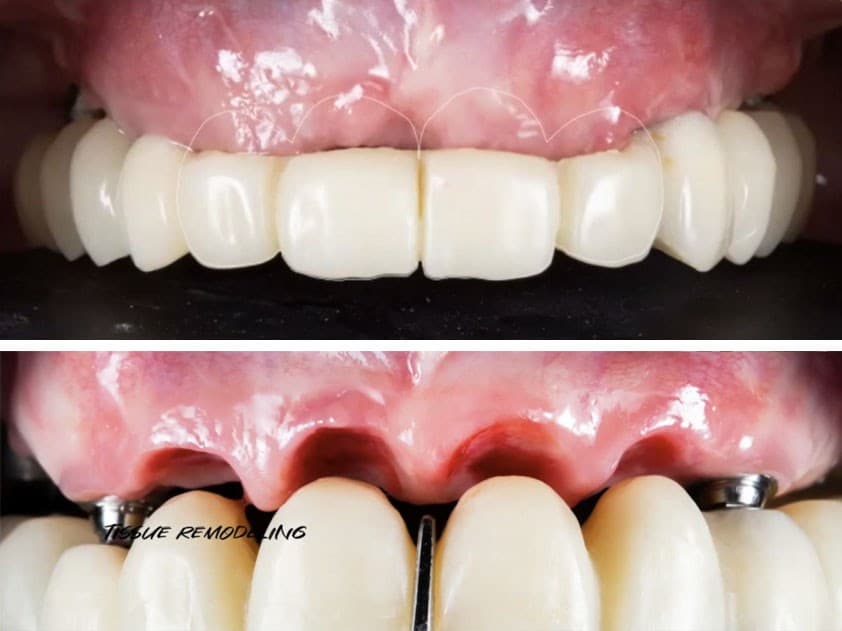
In any restoration or natural tooth, the surrounding soft-tissue profile plays an integral role in the final esthetics of a case. Similarly in implant restorations, it is no longer sufficient to merely attach a prosthetic device to the underlying fixture, but for optimal esthetics it has become essential for the implant site to be reconstituted in a three-dimensional approach. This invariably involves redevelopment or replacement of lost hard tissue and redevelopment of the correct soft-tissue profile,…
|
|
|
Related Courses |
|
|
All-On-Four Implant Protocol - Fad or Phenomena
This webinar with Dr. George Duello and Dr. Maurice Salma will discuss the various treatment options available today for this patient segment and emphasize when and where the All-On-Four protocol can be successfully utilized to eliminate the need for costly augmentation procedures and months of healing time.
| Presented By: |
George V. Duello, DDS, MS |
| Presentation Style: |
Online Course |
| CE Hours: |
1 CEU (Continuing Education Units) |
|
Watch Now>>
|
|
|
|
|
Zygomatic Implants in the Treatment of Fully Edentulous Patients
This presentation aims to bring some possibilities in the treatment of edentulous patients with a severe atrophic maxilla. The major problem is that the absence of an appropriate bone bed, will compromise any approach with bone grafts and substitutes, as well as involving a greater morbidity and treatment time. In this way the oral rehabilitation with zygomatic implants is a current need for many patients, which will require a scientific knowledge of the dental care professional. Through this slide show and video demonstration you will be able to recognize and diagnose cases recommended for the therapy with zygomatic implants and its possible configurations supporting an oral rehabilitation.
| Presented By: |
Alexander D. Salvoni, PhD |
| Presentation Style: |
Online Course |
| CE Hours: |
1 CEU (Continuing Education Unit) |
|
Watch Now>>
|
|
|
|
|
Alveolar Ridge Regenerative Strategies: Autogenous Bone vs BMP-2
This clinical based presentation will compare the use of autogenous bone vs BMP-2 for alveolar ridge reconstruction. The science, indications, advantages and disadvantages of each approach will be featured. Single tooth to full arch reconstruction cases will also be shown along with understanding the application of non-resorbable vs resorbable mesh barriers for alveolar ridge reconstruction.
| Presented By: |
Michael A Pikos, DDS |
| Presentation Style: |
Online Course |
| CE Hours: |
1 CEU (Continuing Education Unit) |
|
Watch Now>>
|
|
|
|
|