Video Details
|
Autogenous Bone Graft - Part 3: Contouring & Fixation
Description:
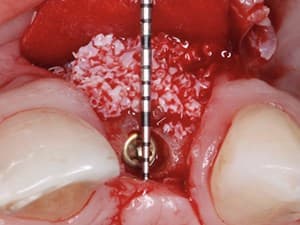
In part 3 of this series, Dr. Michael Pikos demonstrates the techniques for contouring and fixation of a cortical autogenous graft harvested from the ramus buccal shelf. In addition, specific techniques and guidelines are suggested in ensuring tension free closure of the flap over the graft. Membrane use and PRP are also discussed
Date Added:
4/6/2009
Author(s):
Michael A Pikos, DDS
Dr. Michael A. Pikos is originally from Campbell, Ohio. He attended The Ohio State University where he graduated Summa Cum Laude and Phi Beta Kappa. He also g...
[read more]
|
|
Online Videos / Surgery / Bone Grafting / Autogenous Bone Graft - Part 3: Contouring & Fixation
|
Questions & Comments
|
henry salama - (1/22/2013 7:28 PM)
I prefer doing the periosteal realeasing incision just prior to wound closure and final suturing when possible as it allows me to control graft positioning, contouring and membrane placement PRN as well as final stabilization of all of the above without having to manage bleeding and visibility at the same time.
|
michael abba - (1/22/2013 8:58 AM)
Dr korner,
I agree about the periosteal incision , but I think it was done because of "filming purposes"
|
Robert Körner - (1/21/2013 1:38 PM)
Is there nobody out there who asks himself: isn´t this a case that could (or should) have been treated without augmentation?(or at the outmost a little lateral augmentation in the most medial area)
Three Implants of at least 10mm length and sufficent diameter shouldn´t have been a problem.By the way - where are the guidelines for the "crown-implant ratio".Actually we do not really know much about the apropriate legth and diameter of the implants we use. Further I think that is prefareable to do the periosteal incision much more prior to woundclosure, because bleeding will have stopped,when you start suturing, and you have less risk of haematoma.
|
Michael Pikos - (4/20/2010 11:29 AM)
Hi guys,
Sorry I haven’t been more punctual with regard to being part of this blog. Allow me to address some of the questions and concerns that have been posted already regarding flap management for the RBS bone harvest. First, generally speaking, contouring a block graft prior to fixation is always indicated. There are times however where post fixation contouring still needs to be done and when this occurs it can be done predictably with a slow speed burnishing concept that I have shown. Yes, this can put the block at risk but not if it’s done properly. I do utilize particulate mineralized allograft (MinerOss) for any morticing that is necessary with these block grafts and especially when overcontouring is indicated. For the past 4 years now I utilize PRGF as opposed to PRP as a bioactive modifier with all of my bone grafting including sinus grafting from autogenous block grafting, ridge splitting, etc.
The importance of flap relaxation prior to closure of any bone graft be it block bone, mesh particulate, ridge split, etc. cannot be emphasized enough. This technique that I show is of course specific to the mental neurovascular bundle area which not too coincidentally happens to be the area (posterior mandible) where most bone grafts fail – due to incision line opening and / or vestibular dehiscence. More often than not the clinician is too conservative with flap relaxation in and around the neurovascular bundle. Hopefully this helps. Also, it is never a good idea to place implants simultaneously with block grafting in that the remodeling that will occur will result in graft compromise as Dr. Salama pointed out. Always best to stage implant placement with block grafting. Again, hope this helps clarify some points.
Best regards,
Dr. Pikos
|
Fadi Assaf - (4/19/2010 8:40 AM)
Would it be safer to use an electric motor?
|
Maurice Salama - (1/4/2010 12:10 PM)
Milind and Mohammed; Thanks for the posts and questions. I do not believe leaving behind periosteum would have a negative effect on the healing but leaving soft tissue of any kind would be a negative. Denuding the bone as Dr. Pikos shows increases the bleeding of the recepient site allowing mesenchymal cells to emerge from the host bone allowing for better incorporation of the grafted bone. As for placing implants simultaneously, I would avoid that as it increases the risk for a large failure of the grafted area. Better to graft and then come back 4-6 months later and place the implants when dealing with any kind of block graft autogenous, allograft or xenograft. As an additional comment, the biggest risk with these blocks is early flap dehiscence or fenestration. Always make sure to work in a thick tissue environment and gain tension free closure. Hope this helps and welcome to the blog Dr. Salama
|
mohammed shakeel - (1/3/2010 10:34 PM)
could u have placed implants at the same time??
|
milind saudagar - (1/3/2010 7:11 AM)
just watched the surgery. it was very good procedure. my doubt was the bone part which was fixed appeared to be completely denuded of all periosteum & blood. if some amount of tissue would have been present, will it affect healing in any manner?
|
Rand Ollerton - (4/26/2009 4:30 PM)
Very nice description of buccal release in such a way as to not violate the inferior alveolar nerve.
|
|
|
Related Courses |
|
|
Tissue Engineering and Platelet Derived Growth Factors: Evidence Based Therapy
Platelet derived growth factors are now routinely utilized in reconstructive therapy. This presentation describes very detailed and evidence based guidelines for clinicians interested in enhancing their abilities in tissue engineering, especially as it relates to bone augmentation. Specifically, while successful bone augmentation requires the standard surgical parameters of space maintenance, low pressure on the grafts and tension-free flap closure, optimization of this goal requires management and enhancement of the local biological conditions with growth factors. Towards that end, platelet concentrates through the constant release of growth factors are able to promote and enhance new vascularization, provide plasma protein, normal lipidemia, as well as increased collagen and fibrin activity.
| Presented By: |
Joseph Choukroun, MD |
| Presentation Style: |
Online Course |
| CE Hours: |
1 CEU (Continuing Education Unit) |
|
Watch Now>>
|
|
|
|
|
|
|