Video Details
|
The Evolving Role of Soft Tissue Enhancement in Esthetic Reconstructive Dentistry - Part 2 of 3
Description:
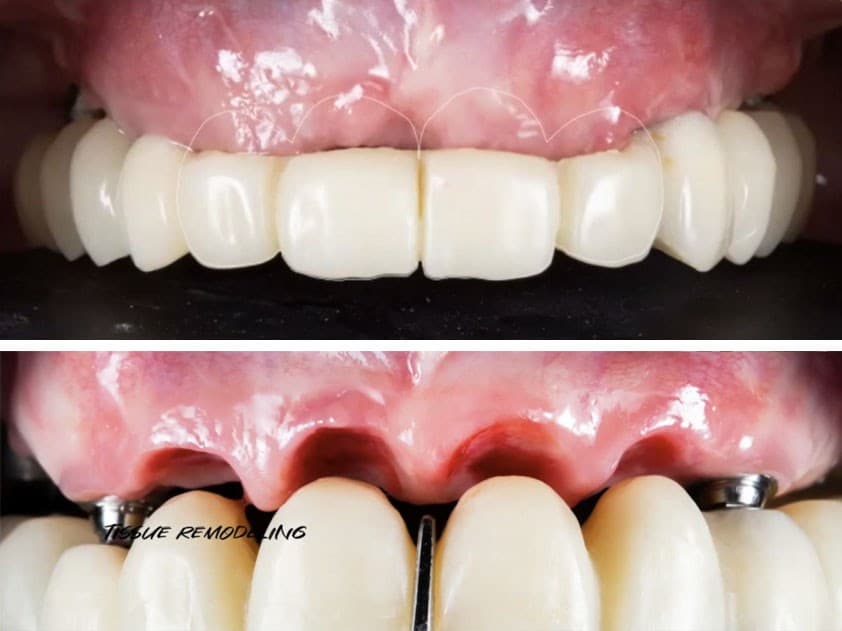
Soft tissue grafting techniques, new regenerative materials and bioactivators will be highlighted. The expanding role of allograft materials (Perioderm), platelet rich in growth factors (PRGF, PRF), and when to utilize them will be suggested. The ability of these combined protocols to alter the soft tissue profile around natural teeth, implants, and dentulous ridges, will be reviewed as to its critical role in "Complete Esthetics".
Date Added:
8/2/2011
Author(s):
Maurice Salama, DMD
Dr. Maurice A. Salama completed his undergraduate studies at the State University
of New York at Binghamton in 1985, where he received his BS in Biology. Dr. Salama
r...
[read more]
|
|
Online Videos / Surgery / Soft Tissue / The Evolving Role of Soft Tissue Enhancement in Esthetic Reconstructive Dentistry - Part 2 of 3
|
Questions & Comments
|
Maurice Salama - (3/10/2013 5:55 PM)
S. Harvey; Surprisingly, the root remains vital and there is no pain. The vital pulp tissue is exposed and then covered by the flap. Blood from the flap maintains vitality of pulp tissues.
thanks Dr. Salama
|
S. Harvey Karpinos - (3/10/2013 4:40 PM)
S. Harvey Karpinos- Is the vital pulp tissue exposed when you submerge the root? Is there any post op pain. Thank you for a great presentation as always.
|
Maurice Salama - (9/30/2011 7:51 PM)
David; No root extrusion noted so far out of 46 cases. Light pressure acceptable over pontic site.
good luck Dr. Salama
|
David Yu - (9/30/2011 1:42 PM)
Dr. Salama, As always- a great and informative presentation. When you submerge the roots, is there any risk of the root extruding? Also, is pressure from the ovate pontic over the submerged root contraindicated? Thanks so much for your expertise.
|
Maurice Salama - (9/19/2011 11:45 AM)
Raed; Thank you. You must Tunnel beyond the MGJ and this must be Split Thickness. The instruments utilized are from Devamed of Germany. good luck Dr. Salama
|
Raed Abutteen - (8/15/2011 5:02 PM)
Thank you Dr. Salama for this very comprehensive presentation. Please explain whether the tunneling extension beyond the muco-gingival junction is of a partial thickness or a full thickness design. Besides, I wasn't able to locate the source of the instruments you are using for the tunneling procedure. Please identify company name. Dr. Raed Abutteen
|
Maurice Salama - (7/31/2011 8:33 AM)
Dr. Tran; Thank you. I always take my own photos and use retractors. Thorough irrigation with sterile water is critical for a high quality image.
Again thank you for the kind comments
Dr. Salama
|
binh tran - (7/30/2011 3:30 AM)
Very informative lecture and excellent photography Dr. Salama. Could you go over how you prepare the tissues before you take the photos? Did you take the photos or have another person do it? Thank you. Binh Tran DDS
|
|
|
Related Videos |
|
|
The Evolving Role of Soft Tissue Enhancement in Esthetic Reconstructive Dentistry - Part 1 of 3
Soft tissue grafting techniques, new regenerative materials and bioactivators will be highlighted. The expanding role of allograft materials (Perioderm), platelet rich in growth factors (PRGF, PRF), and when to utilize them will be suggested. The ability of these combined protocols to alter the soft tissue profile around natural teeth, implants, and dentulous ridges, will be reviewed as to its critical role in "Complete Esthetics".
| Presented By: |
Maurice Salama, DMD |
| Presentation Style: |
Lecture |
| Community Rating: |
|
|
Watch Now>>
|
|
|
|
|
The Evolving Role of Soft Tissue Enhancement in Esthetic Reconstructive Dentistry - Part 3 of 3
Soft tissue grafting techniques, new regenerative materials and bioactivators will be highlighted. The expanding role of allograft materials (Perioderm), platelet rich in growth factors (PRGF, PRF), and when to utilize them will be suggested. The ability of these combined protocols to alter the soft tissue profile around natural teeth, implants, and dentulous ridges, will be reviewed as to its critical role in "Complete Esthetics".
| Presented By: |
Maurice Salama, DMD |
| Presentation Style: |
Lecture |
| Community Rating: |
|
|
Watch Now>>
|
|
|
|
|
|
The Basics of Root Coverage Surgery with Acellular Dermal Grafts: A STEP-BY-STEP Live Patient Demonstration
oft tissue grafting is rapidly playing a larger role in restorative, esthetic, and reconstructive dentistry. While conventional grafting techniques have several limitations, newer grafting materials and techniques make it easier for patients to say "yes" to the treatment they truly need and desire. In this webinar, Dr. Wong will perform a step-by-step demonstration using Perioderm to correct multiple gingival recession defects. Soft tissue allografts are quickly becoming a "game changer" in dentistry, making optimum dentistry more than an ideal... it's a reality.
| Presented By: |
David Wong, DDS |
| Presentation Style: |
Video |
| Community Rating: |
|
|
Watch Now>>
|
|
|
|
|
Related Articles |
|
|
|
Use of the Subepithelial Connective Tissue Graft to Improve Esthetics
The subepithelial connective tissue graft is a gingival grafting plastic surgery procedure that can be used to enhance the aesthetic and gingival contour of the periodontium around dental implants. This technique is described and illustrated to create a soft-tissue root prominence and mask the grey color penetrating the thin labial attached gingival tissues over dental implants.
| Author(s): |
Lee H. Silverstein, DDS, MS, FACD, FICD;Michael D. Lefkove, DDS |
|
View Article>>
|
|
|
|
|
Current Trends in Gingival Recession Coverage
The recession of the gingiva is increasingly becoming a more prominent condition in the oral health of many patients and should be treated at its earliest detection. The multifactorial etiology, decision modality, and current trends followed in the treatment of gingival recession are discussed in this presentation. The correction of Class I and II gingival recessions are presented as a means of minimizing surgical trauma and achieving predictable aesthetic results. Part II of this discussion will present alternative techniques in treating gingival recession.
|
|
|
|