Dental Education
Online Dental Education Dental education lectures and videos Online dental ce Dental education articles Expert dental educators Dental products education Dental Community
 
Video Details
Flap Management and Site Preparation in Anterior Bone Augmentation - Part 2 of 2

Description:
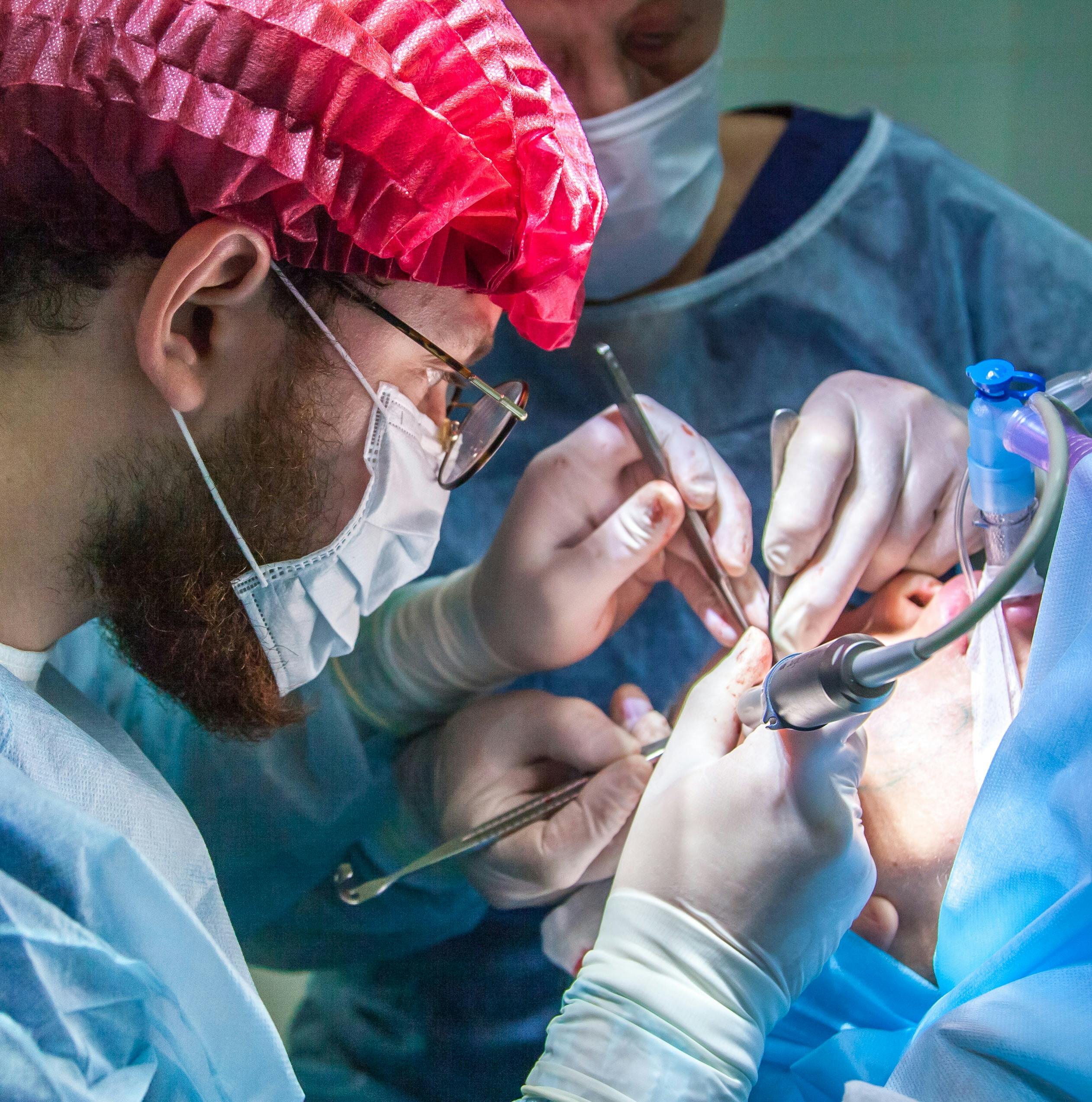
In this detailed, technique oriented, surgical video, Dr. Howard Gluckman outlines his decision making on incision design and flap management in preparation for anterior osseous augmentation in conjunction with implant placement. Specifically, site preparation and implant placement along with emphasis on autogenous bone harvesting from the palate.

Date Added:
6/5/2012

Author(s):

Howard Gluckman, BDS, MChD Howard Gluckman, BDS, MChD
Dr Gluckman completed his dental training at the university of Witwatersrand in Johannesburg in 1990. After spending a number of years in a general practice he complet...
[read more]


Online Videos / Surgery / Bone Grafting / Flap Management and Site Preparation in Anterior Bone Augmentation - Part 2 of 2


Questions & Comments
Howard Gluckman - (11/20/2012 3:36 PM)

@ Jeremy. I dont understand as the osteotomy is done before the bone block is placed. THe block is only placed when the implant is in position. So I dont understand the question about better osseointegration. You are correct about the placement of bone from the bone collector as well as the xenograft in a sandwhich technique over the autogenous block. I have changed a little these days in that I only use autogenous bone and I dont use membranes at all any more I dont find it necessary and I get better flap closure this way. I dont understand the 3rd question can you eplain this one to me as well. With regards to question 4 I always try and use a provisional partial acrylic denture as I can easily control the pressure on the bone and the flap. One can easily remove it and check that the flap has closed well. thanks for the question

Howard Gluckman - (11/20/2012 3:26 PM)

@Faez. THanks for the kind words. THis is not ideal for immediate placement as one would like to have the soft tissue close first. I usually wait 8 weeks which gives good soft tissue closure but very little bone remodelling. With regards to implant insertion torque you can definitely do as you say but I dont find it necessary unless the torque goes way too high. In this case one does not need the primary stanility as one is not going to immediate load or do single stage surgery it will get a cover screw and primary closure will take place. I hope this answers your question

Howard Gluckman - (11/20/2012 3:21 PM)

@Farhan. Primary closure is essential for any successful bone augmentation. Flap management is taken care of at the begining when the flap is raised. One will do a periosteal release of the flap immediately so that any bleeding will subside before you do flap closure. THis will reduce the haematoma formation. Making sure you have enough pereosteal release so that there is no flap tension. I hope this answers your question and thank you for the compliment

jeremy amzalag - (9/16/2012 6:50 AM)

Hi Dr Gluckman, very nice case! I have got a few questions: 1. Why do not you do osteotomy before placing the block grafts? Do not you think the blocks would be better osseointegrated? 2. Are you using a mix of autogenous particle bone taken from the bone collector plus a xenograft particle bone after you place the block grafts? 3. Once you will reenter would not be easier to leave bone-free the top of the implant screws? 4. How are you going to temporize it?

faez amirabadi - (8/15/2012 6:34 AM)

superb Dr Gluckman, was this case indicated for immediat case ? . while placing the implant you went over 50 and then uscrewed the implat to avoid pressure necrosis, is it not risking the primary stability ,is it not better to increase the osteotomy a bit then place the implant.

FARHAN DURRANI492 - (7/27/2012 2:46 PM)

excellent augmentation how do you get good closure

Howard Gluckman - (6/8/2012 6:37 AM)

@ Muhammad The scores we use come from Helmut Zepf they are a german company. If you can get 1mm screw they are even better as the ones I use are 1,2mm. We place the bone over the top in this case as they are ankles implants which allow stability of the buccal bone due to the cone connection. If you are using an implant that is not platformed switched or one that has no cone connection like and internal or external hex then there is no point as the bone will resorb.

Howard Gluckman - (6/8/2012 6:34 AM)

Hi Rob. these type of incisions are typically called papillae saving incisions and have been used for years in perio surgery. they do not lead to loss of the papillae at all as long as you do not cut into the papillae themselves as this may lead to collapse of the papillae from cutting of the periodontal fibres that support the papillae

Muhammad Saleh - (6/7/2012 9:49 AM)

A really great video step by step, but i have 2 questions that i hope you answer them. 1-What type of fixation screws are you using. 2-What is the significance of placing bone graft right on the top of the implant.

Related Videos
Flap Management and Site Preparation in Anterior Bone Augmentation - Part 1 of 2 Premium Member Content

Flap Management and Site Preparation in Anterior Bone Augmentation - Part 1 of 2
Dr. Howard Gluckman outlines his decision making on incision design and flap management in preparation for anterior osseous augmentation in conjunction with implant placement.

Presented By: Howard Gluckman, BDS, MChD
Presentation Style: Video
Community Rating:
 
Watch Now>>
Synergy of Bone and Gingival Augmentation in Tooth Replacement - Part 2 of 4 Premium Member Content

Synergy of Bone and Gingival Augmentation in Tooth Replacement - Part 2 of 4
This lecture will highlight the current available regenerative techniques and protocols to maximize the esthetic results of tooth replacement therapy.

Presented By: Maurice Salama, DMD;Michael A Pikos, DDS
Presentation Style: Lecture
Community Rating:
 
Watch Now>>
Chin Bone Block Augmentation	Premium Member Content

Chin Bone Block Augmentation
3D CT Technology & Piezosurgical Techniques

Presented By: Maurice Salama, DMD
Presentation Style: Video
Community Rating:
 
Watch Now>>
3D Reconstruction of an Atrophic Ridge Premium Member Content

3D Reconstruction of an Atrophic Ridge
Reconstructing a Compromised Central Incisor Site

Presented By: Maurice Salama, DMD
Presentation Style: Video
Community Rating:
 
Watch Now>>
Related Courses
BMP, PRP, PRGF and PRF; At the Edge of Regenerative Surgery Premium Member Content

BMP, PRP, PRGF and PRF; At the Edge of Regenerative Surgery
This webinar will review the wound healing process and the role that growth factors play in regeneration. BMP, PRP, PRF and PRGF will be reviewed and their clinical applications will be demonstrated.

Presented By: Avi Schetritt, DMD
Presentation Style: Online Course
CE Hours: 1 CEU (Continuing Education Unit)
Watch Now>>
New Age Esthetics: Integration of Tissue Reconstruction, Tooth Replacement and Ceramics Premium Member Content

New Age Esthetics: Integration of Tissue Reconstruction, Tooth Replacement and Ceramics
Dr. Miguel Stanley exhibits detailed clinical cases that represent his "No Half Smiles" philosophy integrating site development, tooth replacement and esthetic composition.

Presented By: Miguel Stanley, DDS
Presentation Style: Online Course
CE Hours: 1 CEU (Continuing Education Unit)
Watch Now>>
Alveolar Ridge Regenerative Strategies: Autogenous Bone vs BMP-2 Premium Member Content

Alveolar Ridge Regenerative Strategies: Autogenous Bone vs BMP-2
This clinical based presentation will compare the use of autogenous bone vs BMP-2 for alveolar ridge reconstruction. The science, indications, advantages and disadvantages of each approach will be featured. Single tooth to full arch reconstruction cases will also be shown along with understanding the application of non-resorbable vs resorbable mesh barriers for alveolar ridge reconstruction.

Presented By: Michael A Pikos, DDS
Presentation Style: Online Course
CE Hours: 1 CEU (Continuing Education Unit)
Watch Now>>
Related Articles
Intraoral Autogenous Block Onlay Bone Grafting for ExtensiveReconstruction of Atrophic Maxillary Alveolar Ridges

Intraoral Autogenous Block Onlay Bone Grafting for ExtensiveReconstruction of Atrophic Maxillary Alveolar Ridges
Autologous bone grafting used with dental implants was originally described by Bränemarketal in 1975, and is now a well-accepted procedure in oral and maxillofacial rehabilitation.Placement of an endosseous implant requires sufficient bone volume for complete bone coverage. Furthermore, the pattern of ridge resorption contributes to an unfavorable maxillomandibular relationship, requires angulations of the implants and/or angled abutments, and affects the proximity of adjacent facial concavities(maxillary sinus, nasal cavity) and vital structures(mandibular nerve).

Author(s): Devorah Schwartz-Arad, DMD, PhD;Liran Levin
View Article>>
The Mandibular Retromolar Area as a Donor Site in Maxillofacial Bone Grafting - Surgical Notes

The Mandibular Retromolar Area as a Donor Site in Maxillofacial Bone Grafting - Surgical Notes
The objective of this article is to review pertinent surgical notes related to the safe harvesting of corticocancellous bone blocks from the retromolar area using a trephine bur technique.

Author(s): Ali Fakhry, DMD, MS
View Article>>
The Bio-Derm Ridge Plumping Technique for Pontic Site Development

The Bio-Derm Ridge Plumping Technique for Pontic Site Development
Seibert Class III apicocoronal and buccolingual alveolar ridge defects with associated gingival mucosal atrophy and absence of interdental papillae are common in edentulous areas within the anterior esthetic zone of the maxilla. Normal emergence profiles, critical to achieving esthetic restorations, require restoration of normal hard and soft tissue morphology, including re-establishment of adjacent interdental papillae.

Author(s): Nicholas Toscano, DDS, MS;Dan Holtzclaw, DDS, MS
View Article>>
Contact Us | Privacy Policy | Terms of Use
©2013

Preferred Language: English Flag
Contact Us · Login · Register